
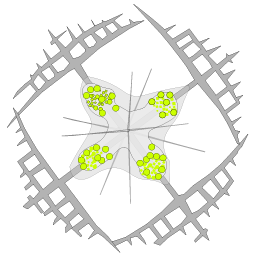

PlanktoQuest is a new virtual reality animation to explore and manipulate the marine plankton with hands. To build PlanktoQuest, we used 3D models of different phytoplankton (microalgae) including their organelles (chloroplast, mitochondrion, nucleus) that we generated with 3D electron microscopy. You can stretch, dissect, feed different plankton as well as entering inside them with just your hands and a headset (no computer, no controllers). This project, which was possible thanks to the financial support of the Gordon and Betty MOORE Foundation and the European Research Council (ERC) under the European Union’s Horizon Europe programme, aims at stimulating curiosity and providing knowledge on the microscopic life of plankton to a broad audience.
Virtual reality is a very efficient technology to communicate with the general public and has the power to engage and inspire students in education. Virtual reality is known to enhance attention, motivation and provides attractive and effective learning. Planktonic microorganisms encompass a tremendous diversity of life forms, and play key roles in marine food web and biogeochemistry of oceanic ecosystems. Despite the crucial importance of marine plankton in the marine ecosystems and the climate of our planet, the general public still has only a diffuse/abstract idea of how all these marine microorganisms floating in the oceans look like. Yet, because plankton is essentially microscopic, it remains largely inaccessible/elusive and unknown, hence insignificant, from the general public and decision-makers. 3D animation is therefore a very attractive and suitable approach to convey scientific knowledge and the beauty of this underwater planktonic world.
Based on virtual reality, we developed the PlanktoQuest project, which aims at unveiling the wonderful and complex microscopic world of plankton and raising awareness on plankton diversity and ecological significance. You can interactively explore inside marine microalgae (phytoplankton) by using just your hands (no controllers): you can choose and catch a swimming plankton, dissect the organelles and learn more from them, feed the plankton with nutrients, and do a 360° voyage inside a cell. We used 3D models from 3D electron microscopy data (FIB-SEM: Focused Ion Beam Scanning Electron Microscopy) of different organelles of microalgae (chloroplast, mitochondrion, nucleus) covering different microalgal groups, such as coccolithophores, dinoflagellates, haptophytes. The immersion in the ocean was further amplified by real sounds from marine organisms, thanks to the expert in eco-acoustics Lucia DI IORIO.
DEMO
More videos of PlanktoQuest on our YouTube channel: @PlanktoQuest
With the financial participation of:
With the institutional support of:
Contacts:
Johan DECELLE: johan.decelle@univ-grenoble-alpes.fr
Faustine FERRARIS: faustine.ferraris@cea.fr
Public events where PlanktoQuest was presented:
2023 April: Lorient (France) Departure of the sailing boat Tara for the TREC expedition, Roscoff (France)
2023 June: Climate Academy in Paris (France) – 2nd edition of the Culture Océan festival by the TaraOcean team Link to the event
2023 June: Tallinn (Estonia) at one TREC site by the TaraOcean team
2023 August: European Phycological Congress in Brest (France) Link to the event
2023 October: “Fête de la Science” Parvis des Sciences – GIANT Campus / CEA Grenoble (France) Link to the event
2024 January: Visit of the Tara boat in Lyon (France). Events at the Maison de L’environnement et Musée des Confluences
2024 February: “Echappées inattendues” CNRS – Musée des Arts et Métiers of Paris (France) Watch the conference on YouTube – Link to the event
2024 March: Institut del Ciències del Mar (ICM) – Barcelona (Spain)
2024 April: Stazione Naples (Italy)
2024 October:
-
- Grenoble tourist office (France) Link to the event
- Cosmocité immersive room, Grenoble (France) Link to the event
- “Fête de la Science” Parvis des Sciences – GIANT Campus / CEA Grenoble (France) Link to the event
2024 November: Vendée Globe starts village on the “La Mer en Commun” stand of the French Ministry of the Sea and Fisheries, Les Sables d’Olonnes (France)
2025 May: Académie du Climat in Paris (France) by the TaraOcean team
2025 May: Biodiversarium in Banyuls-sur-Mer (France)
2025 June: ICOP/ISOP 2025 – 16th International Congress of Protistology in Seoul (South Korea) Link to the event
2025 June: Sea Festival at Villefranche-sur-Mer (France) organised by Institut de la Mer de Villefranche (IMEV) and the municipality
2025 October: “Fête de la Science” in Grenoble (France)
-
- Parvis des Sciences – GIANT Campus / CEA Link to the event
- Alp’in Sciences – CNRS Link to the event
2026 February: “The Cell Biology of Eukaryogenesis and beyond!” symposium organized by the French Society for Cell Biology (SBCF) at Institut Pasteur Paris (France) Link to the event
2026 April: ISOP 2026 – celebrating the 65th anniversary of the first International Congress of Protozoology in Prague (Czech Republic) Link to the event
2026 May: Prédieux Primary school, Saint-Egrève (France)
2026 June: MicroSEA “Microbial Sea Eukaryotes” course held at the Biological station of Roscoff (France) Link to the event
Latest news:
Acknowledgements:
We gratefully acknowledge the financial support of:
-
- The Gordon and Betty MOORE Foundation
- The European Research Council (ERC), funded by the European Union under the Horizon Europe programme (SymbiOCEAN, 101088661)
And the scientific and technical support of:
-
- Julien BRUNET, Florent HAUSS and all the 3Dcreation team
- Team PhotoSymbiosis (Daniel YEE for english translation)
- Planktomania, Fabrice NOT and Alexis DECELLE
- Microscopy Plateform MEM – Benoit GALLET and Guy SCHOEHN – Institut de Biologie Structurale de Grenoble
- Yannick SCHWAB, Paolo RONCHI and Nicole SCHIEBER (European Molecular Biology Lab – Heidelberg)
- Pierre-Henri JOUNEAU (CEA Grenoble)
- Lucia DI IORIO (University of Perpignan) for the sounds of marine organisms